
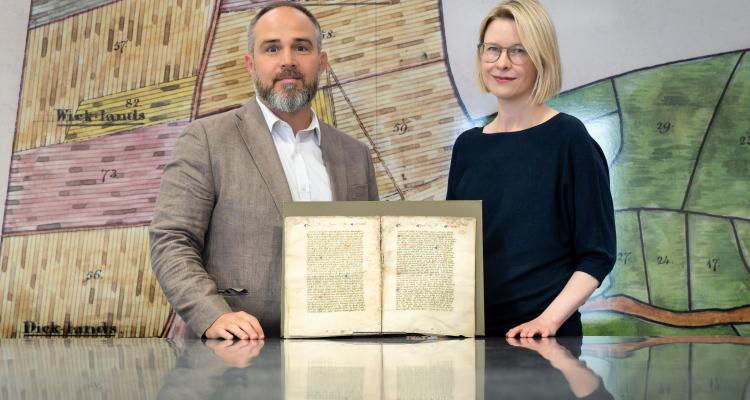
Dr Katie Walter and Dr James Wade in The Keep archive, Brighton, with the fragment of Nicholas Love’s early 15th-century Mirror of the Blessed Life of Jesus Christ. Photo credit: Courtesy of the University of Sussex.
Girton Fellow Dr James Wade and Dr Katie Walter of the University of Sussex have reunited six lost pages of a medieval bestseller with the manuscript from which they were separated, solving a cataloguing puzzle that had frustrated scholars for nearly a century.
The fragile pages, held at The Keep archive in Brighton (UK), belong to a copy of Nicholas Love’s early 15th-century Mirror of the Blessed Life of Jesus Christ now held 3,500 miles away at Yale University. The work was once an approved orthodox bestseller, but became a ‘risk to life’ book a century later in the English Reformation.
Following clues left by archivists and earlier scholars, Dr Wade and Dr Walter examined a digitised manuscript known as ‘Takamiya MS 20’. They identified the precise gap where The Keep pages belonged, then matched the scribe’s handwriting and the missing passage to confirm the connection.
The discovery also prompted a reconsideration of Sir John Gage, a key figure in Henry VIII’s dissolution of the monasteries. Gage’s ownership of the Mirror suggests that the committed Catholic preserved a book of the kind he was charged with suppressing.
Dr Katie Walter says:
“The fact two possible owners before Gage were religious women suggests the manuscript might have been in a monastic house before it came into his possession. The dissolution of the monasteries led to the destruction of many books but others were taken and then circulated through informal networks. Considering Gage’s active role in the dissolution, it’s very possible he acquired the book during this chaos.”
Dr James Wade says:
“One possibility is that John Gage went to a monastic library and brought it home. Another is that someone else smuggled it out, and it briefly circulated from hand to hand until Gage acquired it. The key thing is – he kept it safe when he was meant to destroy books precisely like this one.”
The researchers hope their findings will open up new opportunities to trace John Gage’s perilous steps through the dissolution and Reformation. Dr Wade and Dr Walter’s study is published in Notes and Queries.
Read the full article on the University of Cambridge website and see the discovery featured by BBC News.