
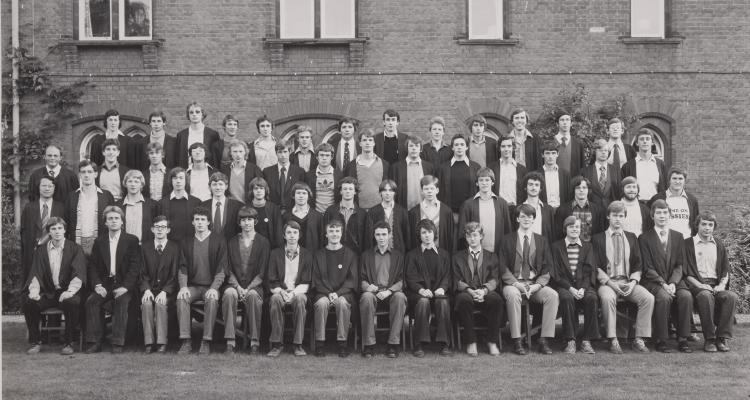
Matriculation photograph of Girton’s first male undergraduates in 1979 (Archive reference: GCPH11 4a/36/123)
Girton’s landmark decision 50 years ago opened the way to male Fellows and students and a new chapter in College life, remembered by four men who experienced the change first-hand.
In 1976, Girton voted to become the first of the women’s colleges at Cambridge and Oxford to embrace co-residence. The decision marked a watershed, but the transformation unfolded in stages: male Fellows joined in 1977, the first male graduate students arrived in October 1978, and 58 male undergraduates followed in 1979.
The groundwork had begun in 1969, under Mistress Muriel Bradbrook, when the College started amending its Charter and Statutes to permit a future vote on admitting men. Those changes were in place by 1971. Five years later, the vote turned that possibility into a commitment.
Girton’s decision formed part of a wider upheaval in university life. Churchill, King’s and Clare began admitting women in 1972, challenging the separation that had long shaped Cambridge. For women’s colleges, the change brought both new possibilities and fears that wealthier male foundations would attract their strongest applicants.
Bradbrook remembered the news of those colleges opening to women as a great liner striking an iceberg: “we had lost our monopoly”. Yet she also invoked Emily Davies’ conviction that “what they did, we did, and if the men went mixed, we must go mixed”. Change could be understood not as abandoning Girton’s tradition, but as continuing its commitment to equality.
if the men went mixed, we must go mixed
– Muriel Bradbrook
There were practical pressures too. The uncertainty surrounding the equal-opportunities legislation of the 1970s: would statutes that now permitted co-education ultimately oblige Girton to admit men? That ambiguity helped tip the balance towards the majority vote in 1976.
Roland Randall, John Marks, John Davies and Philip Ford recalled co-residence as a time of apprehension, friendship and shared determination to make it work. Their accounts appear in 'Girton: Thirty Years… in the life of a Cambridge College' (2005, Third Millennium Publishing), compiled by Marilyn Strathern.
For Dr Roland Randall, who had supervised Girton students since 1972, the attraction was immediate. Offered Fellowships by two Cambridge Colleges, he chose the College embarking on a new era. Girton, he recalled, seemed “vibrant, exciting and above all friendly”. He was pre-elected in spring 1977 and admitted that Michaelmas.
"vibrant, exciting and above all friendly"
– Roland Randall
His interview visit supplied an early glimpse of that friendliness. After Hall, Dr Gillian Jondorf sat on the rug by the hearth in the Senior Combination Room, kicked off her shoes and invited him to join her for a chat. Although he later learnt that the debate over going mixed had been long and heated, Randall remembered never feeling unwelcome.
Not every adjustment was quite so seamless. At High Table, he once poured all the custard sauce over his apple pie, mistaking the communal supply for an individual helping. College business brought surprises too: one Council meeting dispatched its important agenda briskly before spending hours debating a cat-flap for the College cat.
For Dr John Davies, the journey began with a very different impression. Helping chemist Malcolm Gerloch move house at Christmas 1973, he made repeated trips past Girton in a tiny borrowed van. Each time, Gerloch identified the College in a hushed voice: “it’s a College for Women”. Glimpsed through the trees, the buildings seemed impressive but remote, hardly somewhere Davies imagined living.
By 1977, Gerloch was encouraging him to apply for a Research Fellowship, candidly admitting that a successful application would free Davies’ research funding to support someone else. Davies delivered seven copies of his application to the Porters’ Lodge with less than an hour to spare. He won the Fellowship, but arrived that October uncertain about what College life would demand.
At the new Fellows’ welcome party, his nerves peaked as the room turned to look at him. Christine McKie, the only person he recognised, stepped forward and introduced him to people who would become close friends. Davies compared his relief to that of a Titanic survivor reaching the Carpathia: a dramatic rescue accomplished through a simple act of welcome.
survivors of the Titanic disaster could not have felt more rescued than I did
– John Davies
Friendships grew in less formal settings too. Anthony McIsaac organised a Fellows’ cricket team, and all five newly resident men signed up. Davies remembered Betty Wood’s spectacular catch at first slip and the prolonged team celebration that followed. His own batting contribution was brief: “four, four, six, OUT!” Lady Jeffreys complimented the excitement of his innings, while regretting that it had not lasted longer.
Philip Ford, meanwhile, arrived with admiration for Girton’s distinguished modern linguists. He remembered breakfast under Alison Duke’s watchful eye and lively conversation over coffee in the Senior Combination Room, where newspapers prompted discussion rather than replacing it. His Fellowship gave him space to develop his research in French Renaissance literature before a post at Aberdeen brought his Girton year to an early end.
Ford also acquired an unexpected companion: a black cat that appeared in his room bearing occasional gifts of dead mice. He named her Ottilie after his Ottilie Hancock Bye-Fellowship. When he won six cans of condensed milk in a College Christmas raffle, it was Ottilie, he recalled, who reaped the benefit.
Dr John Marks had joined Girton in October 1976 as its second Director of Medical Studies, initially expecting no Fellowship because the Foundation was still restricted to women. In January 1977, he and Dr Frank Wilkinson were admitted as its first male graduates.
He recalled a community determined to make the change work. Under Mistress Brenda Ryman and Senior Tutor Melveena McKendrick, a student committee considered how co-residence should operate. Separate wings for men and single-sex corridors were among the options.
The committee instead favoured mixing throughout the corridors, while allowing for accommodation for those with cultural or religious requirements. When male undergraduates arrived in October 1979, co-residence was intended to mean shared daily life, not simply membership of the same institution.
Marks remembered that the first intake faced more than an academic challenge: they were joining a community in which they would be heavily outnumbered. Yet by the end of their first week, men’s teams in rugby, football and squash, as well as a rowing eight, had been assembled.
Across the recollections, the transition was measured in everyday encounters as much as formal decisions. Randall recalled early wariness among some women in mixed Geography supervisions, eased by Michaelmas field trips. Within three or four years, he wrote, the numbers of men and women reading Geography were often equal.
Marks’ memories ranged from sunny revision supervisions beneath the trees to the men’s eight returning after winning blades, with a flag flying and Ian Laurenson playing the bagpipes in the bow. He also noticed a change in evening life: where students had previously sought much of their social activity in central Cambridge, by 1980 Girton itself had become, in his words, “a hum of youth enjoying life to the full”.
a hum of youth enjoying life to the full
– John Marks
The wider transformation expanded opportunities for women to study at Oxford and Cambridge, although co-residence alone could not guarantee equality. At Girton, the recollections suggest that the vote’s success depended on something no statute could supply: a shared willingness to make the new community work.
Davies believed that willingness extended even to Fellows who had originally voted against the change. His recipe for its success was simple: everyone resolving that “this won’t fail because of me”. Years later, finding himself the only man on a committee, he realised that he had not even noticed. When the Chair apologised, his answer was affectionate and telling: “Girton College has trained me magnificently”.
By 1983, the College had reached a gender balance among undergraduates. The vote of 1976 had changed who could belong to Girton; the years that followed showed how that belonging could work, even as newcomers learnt that the custard was for sharing. In Randall’s and Marks’s recollections, the enduring story was not simply the arrival of men, but the welcome that made the transition possible.
This article draws on ‘Girton: Thirty Years… in the life of a Cambridge College’, compiled by Professor Dame Marilyn Strathern (Third Millennium Publishing, 2005). The recollections featured here are those of Drs Roland Randall, John Marks, John Davies and Philip Ford.