
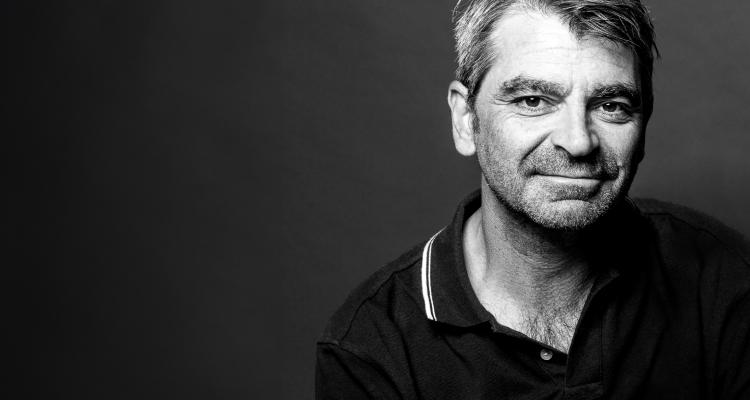
Photo Credit: Graham Haber
Internationally respected author Joseph O’Neill talks about how his globetrotting childhood shaped his style, his golden rule for writing, and the power of studying literature today.
Joseph O’Neill (1982 Law) remembers two things very clearly from his time at Girton in the early eighties. The first is “long, labyrinthine corridors”. The second is “kindness”.
He experienced both first-hand during his final year. When his off-campus landlord decided to sell his lodgings, Girton stepped in to offer him a vacant Fellow’s room in the College while he crammed for his crucial exams. “I lived quite comfortably there, in solitude, in my idyllic room in a tower”, he says. “Perhaps too comfortably.
“I’d become a little too used to wandering down in my pyjamas, smoking and unshaven, to collect my mail. One time, a group of potential parents or benefactors suddenly appeared around the corner,” he laughs. “I got a kind note later asking me if I would mind possibly getting dressed before I ventured downstairs in future.
“That’s the sort of thing I remember. That wonderful sense of forgiving gentleness and kindness, and how they all looked after me.”
There is something vaguely familiar about the character in that anecdote, feeling their way through a vivid, strange environment that is not their own. There are echoes of it in some of O’Neill’s most celebrated novels, from Hans’ experiences of post-9/11 New York in Netherland to the protagonist of The Dog, fleeing a broken relationship to work for a super-rich family in Dubai.
This is probably not a coincidence. O’Neill was born in Ireland, but his mother is Turkish, and much of his early childhood was spent following his father’s construction work around the world. “I’m an early example of what they call a ‘third-culture kid,’” he says. “Most writers inhabit a particular culture and write out of that culture. That’s trickier for me,” he reflects. “As a third-culture kid, you have a passport and a nationality, but even when you’re back in your supposed homeland, there’s still that sense of being abroad. It feels like I’m abroad wherever I go.”
While that feeling was always there, it wasn’t until he moved to New York in 1998 that O’Neill fully realised how it defined him as a writer. “I became quite deracinated and found myself, in a terrifying sort of way, able to write this novel about a Dutch person playing cricket in New York. Obviously, the details of the plot were not mine, but the situation was not a million miles away from my own. In that way, I felt like I was able to access who I was.”
That novel was Netherland, an award-winning tale of cricket, friendship, and alienation. The 2008 book received critical acclaim and even made it onto President Barack Obama’s recommended reading list. However, it is not O’Neill’s favourite of his novels.
That accolade goes to The Dog, the follow-up that arrived in 2014. O’Neill immersed himself in philosophical texts, challenging himself to conjure up the theorising voice of the protagonist.
“It has that hyper-logical, slightly neurotic voice, which was the most fun for me to read and write. I can actually re-read bits of The Dog and find it enjoyable, which I can’t do with some of the others.” That love of voice is at the heart of O’Neill’s writing, along with a reverence for style.
“I’ve come to understand myself as a ‘stylist’. I tend not to plot by having action points that I’m writing towards. I almost plot a sentence at a time, and each sentence is a unit of surprise or gratification.
“Style doesn’t necessarily mean you’re writing flowery language all the time. It just means that you’re properly attentive to your medium, and that you try to create a world in a way that is unattainable in other forms.”
“I feel like the only rule about writing is that it should be accurate, and surprising. If you’re surprising people without giving up on accuracy, then you’re writing well.”
O’Neill’s latest novel, Godwin, is a testament to his appreciation of style. But there’s something else there, too. “I don’t think I’d ever written a book as eventful as that before”, he says. “I’d always written books that were more ruminative, whereas in Godwin, you’re racing forward all the time. I got drawn into this adventure story.”
Godwin is the tale of Mark Wolfe, a technical writer from Pittsburgh who unexpectedly finds himself sucked into the search for the eponymous young African football prodigy. Watching this mysterious child play on a short video, the siblings see the prospect of wealth and status – for the person that discovers him.
The book is a treasure hunt of sorts, building the excitement as the global race for this prodigy intensifies. It’s also a book about the Business of Football, and how the vast riches of the global game are felt across cultures and continents.
However, Godwin is not just Mark’s adventure. O’Neill also weaves in another voice; one that appeared as he grappled with his main character during the writing process. Lakesha runs the technical writing co-op that Mark is part of, and her struggle to maintain and protect it anchors the story as the quest for Godwin progresses.
“I was several years into the writing of the book when this quiet, calm, slightly scientific voice came to me. I wasn’t sure why she appeared at first, but you have to listen to what your imagination is telling you, even if it’s worrying and uncertain.
“There’s definitely a power in having a single voice at the centre of the novel, but ultimately in this case, the imbalance made the book more interesting for me.”
So, what’s next? Godwin emerged a decade after the publication of The Dog, and O’Neill admits that he is not sure he will write another novel.
“Actually, I feel more like a real writer when I’m not writing. I try to keep it as voluntary as possible, which can lead to big gaps in my writing habits.
“However, I’m always thinking about this business of making sentences and making text and enjoying it…or trying to.”
That impulse is currently finding its form in different ways. He is still writing short stories, as well as articles about the current political situation and the state of the USA’s Democratic Party. He’s also a Visiting Professor of Written Arts at Bard College in New York.
O’Neill notably opted to study Law over English Literature at Cambridge, as he felt the latter was “too precious to study”. However, he has since developed a strong appreciation for the subject and its value in today’s world.
“The study of literature is more relevant today than it has ever been, as it’s essentially a study of interpretation. You have to be able to interpret the writing, but also the world in which it belongs.
“I think the political crisis we’re having is, to a significant extent, a crisis of interpretation. For example, climate change is basically a bunch of stories about what’s happening to the climate, and people need to be able to understand and interpret those stories, and what they mean.
“So, it’s a wonderful time to be studying literature, because it gives you the skills to understand and survive the world around you.”