
“The purpose of studying economics is not to acquire a set of ready-made answers to economic questions, but to learn how to avoid being deceived by economists.”
– Joan Robinson
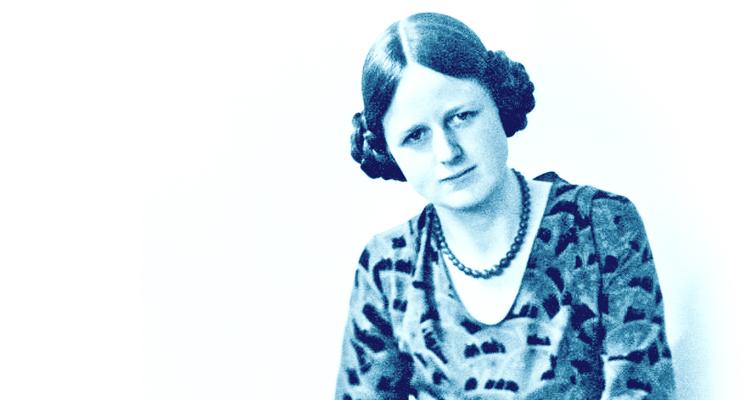
Joan Robinson: Girton’s radical economist and her enduring legacy
Joan Robinson never did things by the book. As one of the most original economic thinkers of the 20th century she refused to play by the rules – neither of the discipline, nor of the institutions to which she belonged.
Today, she is remembered as a trailblazer of the Cambridge School of Economics, but at Girton, she remains something more: a symbol of what it means to challenge orthodoxy with brilliance, courage, and conviction.
She never received a Nobel Prize. Yet among economists, she is often remembered as “the greatest Nobel Prize winner that never was”. Her contributions were vast, her politics – radical, and her influence – undeniable.
A woman in a world that wasn’t ready
When Robinson – then Joan Maurice – arrived at Girton in 1922, Cambridge was still refusing to grant degrees to women. She graduated in economics in 1925 but left without a degree – a “great disappointment”, she later said.
After marrying economist Austin Robinson in 1926 and spending time in India, she returned to Cambridge determined to make her mark, but her progression through academia was slow. Despite her growing reputation, it wasn’t until 1965 – more than 30 years after her first appointment to a lectureship – that she was promoted Professor of Economics. Many believed her husband’s position in the same department delayed her promotion. At the time, opportunities for married women and female scholars at the University were limited. But figures like Robinson would force the change.
Praise was often tinged with condescension. One colleague, Gottfried Haberler, described her work as “much too clever for a woman”. Robinson rejected the label “woman economist” – she simply wanted to be known as an economist but her presence at the top of the field was revolutionary. She opened doors, not with slogans, but with substance.
An intellect that refused to sit still
In 1933, Robinson published The Economics of Imperfect Competition – a direct challenge to the prevailing free-market theories of Alfred Marshall. She introduced the concept of monopsony, showing how dominant employers could hold wages below what workers were worth. She used it to explain the wage gap between men and women – and the theory became widely accepted. Nearly a century later, the US Supreme Court would cite it in a landmark labour case.
She was also a key member of the Cambridge Circus, a group of young economists who helped shape Keynes’s ‘General Theory’. Keynes shared drafts with her, and she responded with critiques. Their collaboration helped turn Keynesianism into a global force.
In The Accumulation of Capital (1956), Robinson again challenged orthodox economic thinking by reframing capital and income distribution as political, not merely technical, questions. This was a pivotal move – shifting the debate from abstract models to the real-world dynamics of power that shape economic outcomes.
She later called for a “spring cleaning” of the discipline, clearing out the dogmas that no longer addressed real-world problems. Economics, she believed, must be grounded in history, ethics, and human experience – not just elegant mathematics. In other words, for Robinson, economics was truly a political science, not just a technical science rooted in calculations and theories of economic equilibrium.
Provocative politics, enduring relevance
Robinson was never afraid of controversy. She engaged seriously with Marx’s work, explored planned economies, and visited Mao’s China and even North Korea. Her commitment to humanity and the human state meant that she believed economics should confront suffering, not ignore it.
Many of the questions she explored remain highly relevant today. Discussions about market concentration, the persistence of income disparities, and the limitations of growth-focused policy reflect themes she had examined decades earlier. Her caution against an over-reliance on mathematical modelling now resonates broadly within the field. Dr Andonis Ragusis, Joan Robinson Fellow in Heterodox Economics at Girton College notes:
“Joan Robinson reminds us that economics serves people, not dogma: a Girtonian who opened doors, unsettled received wisdom, and championed courage, realism, and historical understanding. Her spirit continues to shape our work and community.”
What if we had listened?
Robinson was not successful in changing ideologies in her lifetime. Her attempts to bridge, reconcile and “spring clean” the separation between neoclassical and classical economics weren’t embraced. But imagine if Robinson’s ideas had exerted a stronger influence on economics after the Second World War. Her views on wages and market structures pointed in a different direction, and while we will never know what would have happened, they still offer a fresh way of looking at the economy today.
A Girton legacy
Robinson lived her beliefs. A strict vegetarian, she famously slept in an unheated hut in her garden, walking barefoot to breakfast each morning. She once described herself as “simple-minded” – not out of modesty, but because it let her see things clearly, and act. Professor Maria Cristina Marcuzzo – in a lecture for the Girton Economics Society – begged to differ:
“I don’t think Joan Robinson was simple minded, she was intellectually daring.”
Girton celebrates her with an economics society, a fellowship, and a workshop series that bear her name, but her greatest legacy may be her example: of what it means to challenge from within – to belong to an institution but also to reshape it.