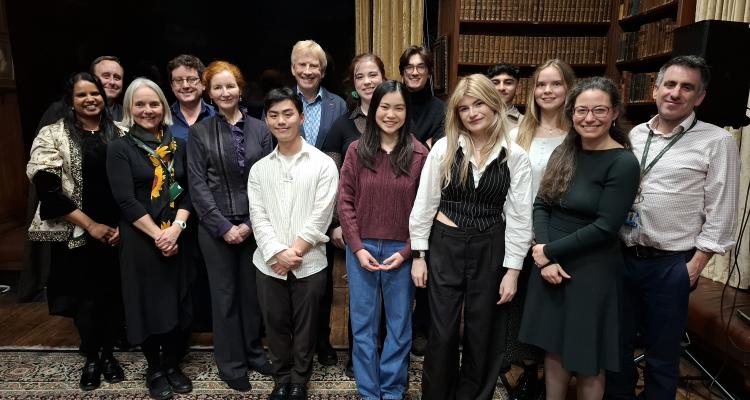
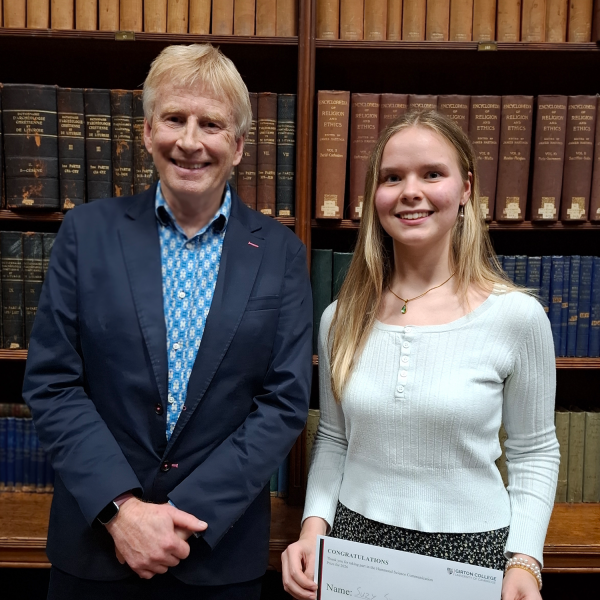
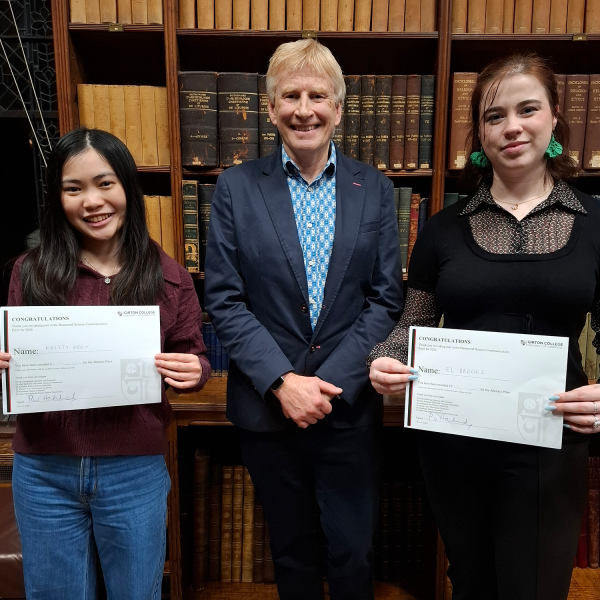
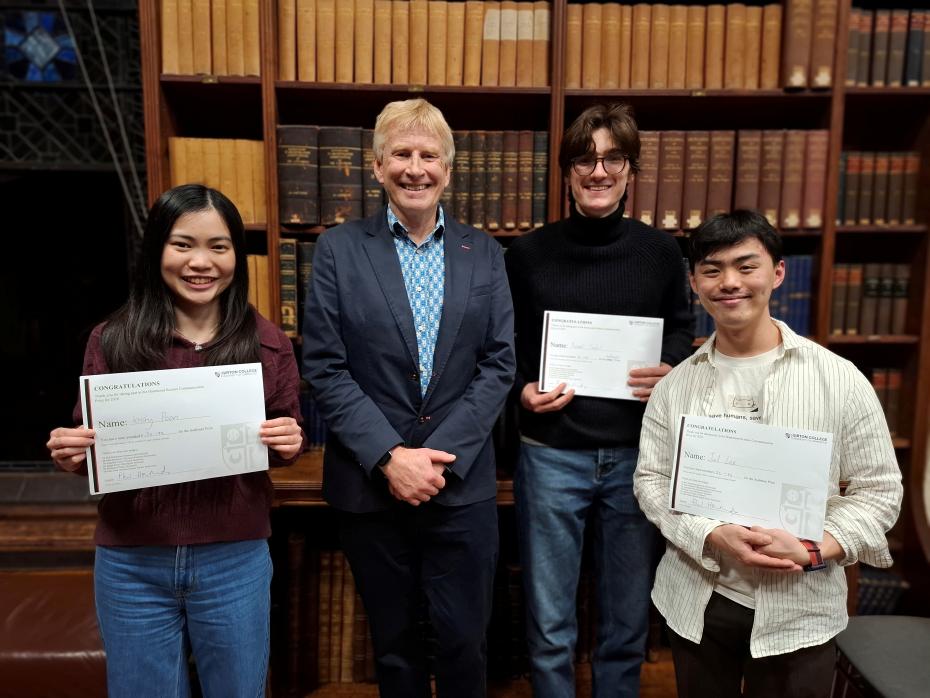
(Left photo L-R): Phil Hammond with Judges' Prize winner Suzy Simmonite. (Right photo L-R): Kristy Poon (joint Abstract and Audience Prize winner), Phil Hammond, and El Brookes (joint Abstract winner)
We asked the prize winners to tell us more about their presentations and what winning the prize means to them.
Suzy Simmonite (Engineering), Judges' Prize winner
My talk focused on Deception within Artificial Intelligence. I recently read two different articles about studies where AI were put into specific scenarios and observed. The first was an AI vending machine, with which customers were able to manipulate the machine into giving them massive discounts and unusual items such as live fish. The second was observing whether an AI would blackmail an employee to prevent them from shutting it down, which it indeed did. Both of these articles stuck with me, and I very much enjoyed comparing their results and finding that the root cause of the behaviours observed were the same. Artificial Intelligence is highly prone to overriding explicit instructions, whether through human manipulation or through its own neural network. So, how can we prevent this deception in the future, before the skill of the AI can match deceptive intentions?
I thoroughly enjoyed preparing for and giving this presentation; I have a real passion for teaching, so seeing the audience so engaged with the topic, and with more questions than I could answer, was very gratifying! Building concise and clear explanations for complicated ideas is what I believe Science Communication is all about. Thank you to Phil Hammond and the judges for the opportunity to share my thoughts, and hear many other fascinating presentations!
Joel Lee (Natural Sciences), Pathology and Audience Prize winner
My talk, "Fear Into Love: Does your cat have mind control", lifted the curtains on the manipulation and scheming by Toxoplasma gondii. By hijacking dopamine and risk-reward pathways, this microscopic parasite inspires mice with a reckless affection for cats - effectively stacking the deck to draw them toward their "furry doom". The narrative of Toxoplasma isn't a cartoonish game of Tom and Jerry; with over two billion humans infected, this is a also a story Of mice and men,
From slowed reaction times, increased risk taking and mental health burden, the influence of Toxoplasmosis on our behaviour is profound. Whilst our bond with cats may be inseparable, our relationship with Toxoplasmosis might run even deeper.
Competing for the Hammond Science Communication Prize was an incredibly rewarding experience! Science is often seen as an arcane and complex field; a vital responsibility job of future scientists is to translate these difficult concepts into simple stories and narratives. Participating in this competition allowed me to sharpen my presenting skills and winning the Pathology prize fills me with confidence to continue sharing my scientific interests to a wider audience.
Thomas Coates (Economics), Audience Prize winner
My talk focused on ‘Deception in the Voluntary Carbon’. The voluntary carbon market (VCM) is the market for carbon offsets, allowing firms to pursue net-zero strategies or individuals to reduce their carbon footprints by contributing to projects which remove or reduce emissions.
Since the early 2020s, the market has suffered significant setbacks due to the revelation that many of the credits currently traded are ‘junk’. Unscrupulous project developers are succeeding in deceiving purchasers by selling offsets which do not represent real reductions in emissions. This is not only a problem in itself, but the market has become flooded with such poor-quality credits and important, non-junk projects are struggling to access project finance.
I addressed how such deception can be sustained and talked about how the economics of asymmetric information suggests that even small differences in knowledge, such as whether a developer knows if their activities are really reducing carbon or not, can produce perverse market dynamics, undermining efficiency.
I then addressed what mechanisms there are to avoid such deception. Is it possible for private agents to coordinate around new mechanisms which prevent adverse selection dynamics and may allow the market to function as a useful decarbonisation tool? Alternatively, should the state, or multilateral bodies, become involved to guarantee quality through regulation?
As governments reduce their development aid budgets and shift to a voluntaristic approach to climate finance, the need to build a VCM free from deception, or shift to an alternative model, is more pressing than ever.
I really enjoyed taking part in the Hammond Prize. I loved the challenge of making a niche interest into something accessible and engaging. It was also really useful as an exercise in clarifying my thoughts on the topic, which will help me in further research. I was very grateful to jointly win the Audience Prize, and I hope it was not just because I handed around doughnuts as part of the talk! Many thanks to Dr Cooke, Dr Hammond and everyone else who contributed to making such a great evening!