
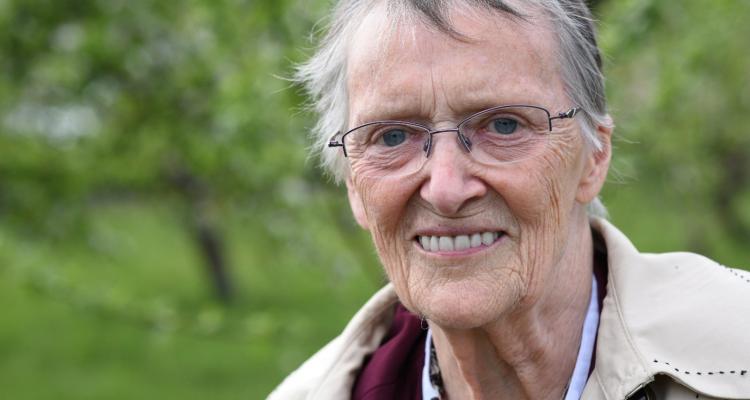
It is with great sadness that we announce the death of Life Fellow Dr Gillian Jondorf, a deeply valued member of Girton’s community whose contributions spanned many areas of College life.
Born in Cambridge in 1937, Jill, as she liked to be called, came up to Girton in 1956 to read Modern and Medieval Languages, beginning a lifelong association with the College. On completing her undergraduate studies, she pursued a PhD on sixteenth-century French tragedy.
After three years of graduate work, including a year spent in Paris, a city that remained especially dear to her throughout her life, Jill was offered the choice between a Research Fellowship at St Hugh’s College, Oxford, and a temporary Assistant Lectureship in Glasgow. She chose Glasgow, partly because of a desire to experience life in Scotland, partly because she was keen to teach rather than to spend more time devoted solely to research. She spent a very happy year there, during which she married Werner Robert Jondorf, a research biochemist who was born in Nuremberg in 1928. They had four children.
When the Glasgow Lectureship came to an end, Jill moved to the United States with her husband. His longstanding interest in the pre-Columbian cultures of Mexico had developed during his time as a visiting scientist at the US National Institutes of Health in the late 1950s, and they used their vacations to travel widely in Central and South America.
When Jill returned to Cambridge in 1971, she was appointed to a University Lectureship and became an Official Fellow of Girton College, a position she held for thirty-three years. In that time, Jill undertook all sorts of jobs, including directing studies, serving as a tutor, acting as Secretary to Council, and editing the Newsletter (predecessor of the Annual Review and, later, The Year). She also spent eleven years and three months in two stints as Vice-Mistress serving, for a time, as Acting Mistress.
One of Jill’s most distinctive but largely unsung contributions to the College was the creation, over more than two decades, of its memorial plaques. Thoughtfully crafted and deeply reflective of the individuals they commemorated, these memorials demanded not only factual precision but also imagination. Writing in the article ‘Lasting Impressions’ in the 2018 issue of The Year, she reflected on the challenges she encountered: ‘The most interesting or difficult thing is the choice of a motto or quotation to complete the inscription […] Finding these can be an adventure or a struggle’. The search for the perfect words led her into wide-ranging conversations with friends of the person commemorated, and she often drew on their memories, insights and suggestions. Later, when Council established the Plaque Committee, Jill and her colleagues were instrumental in shaping a body of work that became an important part of College tradition.
Upon her retirement in 2004, Jill was elected a Life Fellow. She remained an active member of the Girton community, attending research talks, concerts and other events on a regular basis. She was known even to the newest Fellows in her role as Chair of the 1954 Book Club, doing brisk business at the Club’s legendary annual black-tie dinner. Until shortly before her death, she continued to work as the main copy-editor of The Year; her exceptional insight and rigour in this role was appreciated by even the most seasoned writers.
Another highlight of her later years was translating the source texts and devising succinct, poetic English surtitles for a series of semi-staged productions in Ancient Greek and other languages directed by Professor Patrick Boyde, formerly the Serena Professor of Italian. The featured works included texts from the New Testament as well as pieces by Homer, Dante, Virgil, Sophocles, Aeschylus, Corneille and Adam Mickiewicz.
In 2004, Jill was made an Honorary Friend of the Royal Society of Portrait Painters in recognition of her role in setting up People’s Portraits, a collection celebrating individuals from all walks of life that has been housed at Girton College since 2002.
Jill’s contribution was immense, and her absence will be deeply felt by all who had the privilege of knowing her and working with her, especially friends and colleagues from across the College and University.