
Feature

Sun, Sea cables, and grit: A Girtonian's Bet on Renewables

Graphic containing the sun, Mark Walsh and solar panels

By Mark Walsh (1997 English)

You’ve probably heard some version of this thought experiment: You’ve probably heard some version of this thought experiment: How much of the Sahara Desert would need to be covered with solar panels to power Europe? It’s usually accompanied by a picture of some tantalisingly minuscule strip of uninhabited nowhere, and a lament: Why doesn’t someone just do it? 

The punchline: This is why we can’t save the planet. Useless humans. 

Mark Budd (1994 Mathematics) has heard the argument. Unlike most, however, he might be on the verge of doing something about it. 

It was 2020, and Budd was looking for a new challenge. An old friend approached him, Budd recalls, and said, “Let me talk you through my idea, and you can tell me if I’m crazy – I listened to him, and I said, ‘You’re crazy.’” But the friend – Simon Morrish – was very serious. Morrish, a British entrepreneur, made his fortune in environmental services and has since pushed green initiatives in energy generation and transport. 

As Budd listened, the idea began to sound less crazy. Less crazy, but still fiendishly difficult. “You’ve actually got huge barriers to this,” Budd says. “Securing land. Securing connection agreements. Getting the permits for the transit countries.” There was also the challenge of navigating the intermittent nature of solar power generation and other renewables – such as wind – which means finding solutions to battery storage problems. And then there is the need to develop heavy-duty cables to transfer the power thousands of miles. Daunting. 

But Morrish persisted and when he once again approached Budd to join the project, baptised Xlinks, the equation had changed. Feasibility studies had been conducted, and a swath of the Moroccan desert identified as a suitable location. Similarly, the march of technology and the desperation to avoid climate catastrophe had driven down costs and ramped up motivation among governments. “When he went through the numbers, it slowly became less crazy,” Budd says. 

I thought, let’s go for it. Let’s see if we can change the world.” 

The concept that Budd has been helping to guide could generate electricity in Africa for transmission to Europe and help meet a significant share of the demand of a major European country – “the largest renewable-energy project outside of China.” 

There’s a certain irony in a son of the North Midlands’ coalfields helping to lead the charge away from fossil fuels. Budd grew up in Sutton-in-Ashfield; his mother was a machinist, and his father was a miner before also working in a textiles factory. Budd was an only child, and it was a tight-knit, happy family. A working-class community where people grafted hard. But also, one with narrow horizons, and not one where academic excellence was usually expected. 
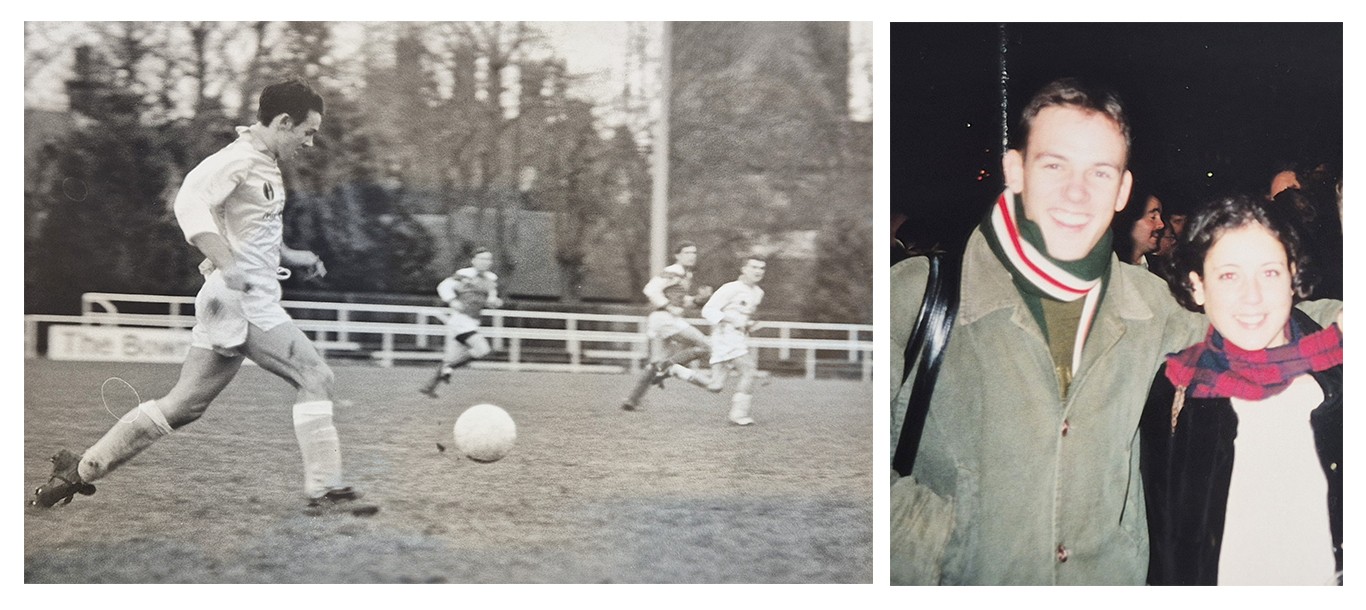
Left: Mark playing Blues football in his student days. Right: Mark with his now-wife Naomi during their time at Girton.
Even Budd finds it difficult to say what drove him. “When I start things, I like to finish them,” he says. “And that lends itself well to a school environment, right?” He shrugs. “I was hard-working, I was disciplined. I was able to do well in all my subjects…” He shrugs again, “I was lucky.” 

Another sign of an academic mind: “I loved puzzles. I did puzzles, and puzzles and puzzles, and I enjoyed solving maths problems, which are, really, just puzzles in a different form.” 

He was also a talented sportsman, and, perhaps, that insulated him from the insults that might have come his way for being good at school. “I think if I’d have been academic and not sporty, things would have been quite different,” he admits. 

Budd was so good at football, in fact, that he was taken on by his local professional team, Mansfield Town, at 16. 

But as he continued to sail through school, a wrenching question loomed: What would be the best bet for his future: university or football? “That was the first time we had a family conversation about it,” Budd says. “It was Mansfield Town, not Manchester United. I kind of knew I wasn’t good enough to be real top level. I didn’t quite have that cockiness or that confidence that the best footballers need.” 

He also had options. Storming through his Mathematics, Chemistry and Physics A-levels, Cambridge came into view. A teacher took him to an open day, and something clicked. 

“When you’re from my part of the world, you’re not used to beauty,” he says. “Even the most generous person would not describe Sutton or Mansfield as pretty or attractive in any way, and then you’re in Cambridge, and it’s just, wow. Wouldn’t it be incredible to live here and study here?” 

Fortunately, back at his comprehensive school, which had no particularly strong history of sending students to university, let alone Oxbridge, Budd found an old box, with a yellowing brochure – and a description of Girton. It looked ideal – a mix of sexes, plenty of state-school students, beautiful buildings. 

There was still a problem, though. Budd’s school didn’t offer Further Maths as an A-Level. He had to teach himself over the summer. 

“At the interview at Girton, I had to explain to them that I’d taught myself. I think they probably saw that as a sign of someone who was really determined. And that probably counted in my favour.” He pauses.

 “One of the reasons I’m so fond of Girton is that other Colleges in the University wouldn’t have taken that chance. Whereas Girton were like, ‘let’s have a punt.’” 

The memory of what came next puts a bit of steel in Budd’s eye. He had to catch up. Quickly. “My knowledge of maths was exhausted within that first week,” he explains. After his first term, he was pretty much bottom of the class. But the work ethic instilled by his parents – plus a belief that he could make up the gap – pushed him on. Between playing football – he would win three Blues – and adapting to university life, Budd played hard and worked even harder. Every year, his results improved; every year, he moved up the list of his peers. He finished with a First.

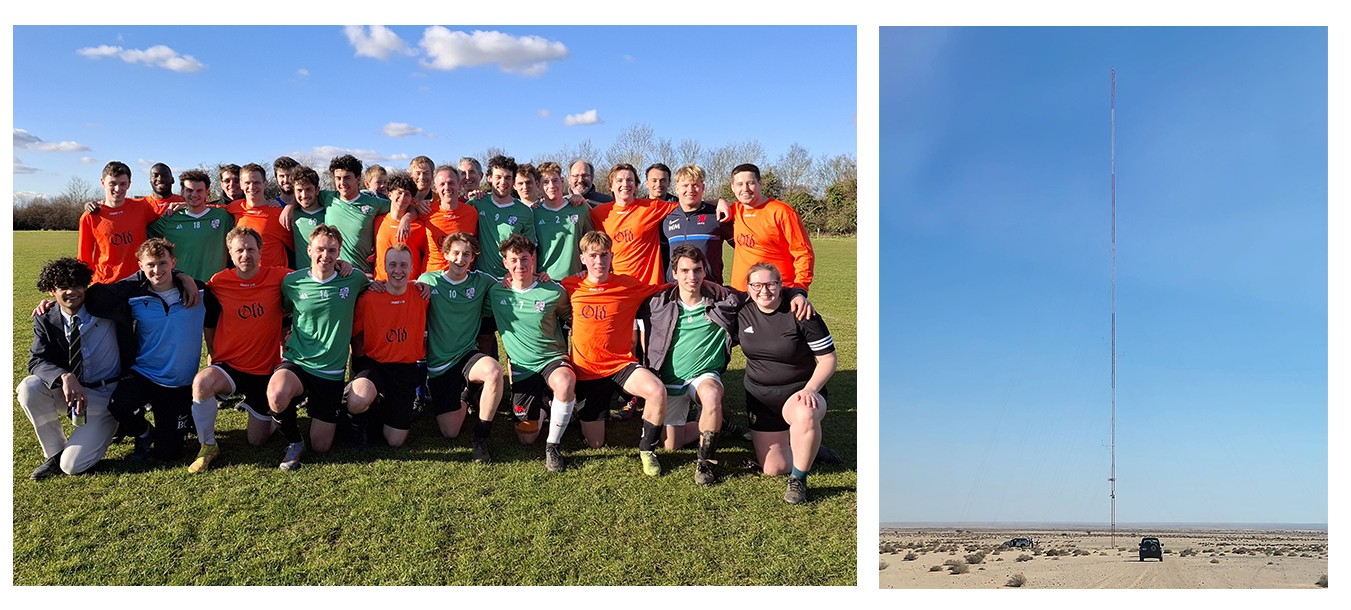
Left: Mark and football teammates, centre, pictured next to his son, Matt (Green, number 9) who is a current Girton student. Right: An Xlinks measurement station in the Moroccan desert.

“It was instructive,” Budd says ruefully. “It pushed me to my boundary. After doing that and getting through to the other side, I always knew that I had more gas in the tank, if I needed it. So, when I had hard times in the future, I knew I’d been through something pretty tough before, and that’s been incredibly useful in my career.” 

After Cambridge, where he not only excelled academically but also met his wife-to-be, fellow Girtonian Naomi Hill, Budd worked in banking briefly before joining the management consultant McKinsey. He went on to gain an MBA at Stanford in 2002 and later moved into private equity with a company called TDR Capital, working for more than a decade on several projects to turn around faltering businesses, including the leisure chain David Lloyd. 

At this point, Budd had built a successful track record but was ready for something a little different. That was when Morrish approached him. 

Xlinks has recruited other industry “big hitters”. “We’ve got some of the best people,” Budd says, citing fellow board members Sir Dave Lewis, a former CEO of Tesco; Sir Ian Davis, a former Rolls Royce chairman; and Paddy Padmanathan, a leading name in solar generation. 

The project aims to have all the structures in place – planning, permits, agreements, site licences, procurement – for an investor to come in with the funds to build everything. “We will do everything apart from physically going and putting the wind turbines, solar panels and batteries in place and connecting things up,” Budd says. “If we were working at corporate time scales, this would take 15 years, but we’ve been going incredibly quickly.” 

As a rule, such large-scale infrastructure projects rely on governmental support, and Xlinks is one of a wave of projects that reflect Europe’s interest in clean energy generated in North Africa, and in exploring whether importing power made in ideal conditions beats domestic production on cost. 

Naturally, the UK was considered as the flagship destination. The Moroccan government had granted land the size of Greater London and an export licence. The undersea route was charted. A landing site in the UK had been secured, and there was a connection agreement with the National Grid. Procurement processes had been completed. The project was set to come online at the start of the next decade.

Electricity would travel almost 4,000 kilometres through undersea cables protected by insulation, lead and steel, with very little transmission loss. If built, it would be the largest such interconnector, able to power 7 million homes for 20 hours a day at half the cost of nuclear in half the time (smaller subsea networks already tie the UK to nearby European states). 

However, in June 2025, British government officials announced that the UK was stepping back from the £25bn Xlinks project and instead was pivoting to other initiatives seen as less risky and focused on developing domestic clean power generation. Xlinks’ high-profile nature led to various other European, Middle Eastern and African governments expressing interest, and several alternative projects are now underway. 

“This could transform how the world thinks about electrical grids and the energy transition,” Budd says. “Which would be a legacy for anyone, right?”

Read more articles from The Girtonian on Issuu.