By Mark Walsh (1997 English)
You’ve probably heard some version of this thought experiment: You’ve probably heard some version of this thought experiment: How much of the Sahara Desert would need to be covered with solar panels to power Europe? It’s usually accompanied by a picture of some tantalisingly minuscule strip of uninhabited nowhere, and a lament: Why doesn’t someone just do it?
The punchline: This is why we can’t save the planet. Useless humans.
Mark Budd (1994 Mathematics) has heard the argument. Unlike most, however, he might be on the verge of doing something about it.
It was 2020, and Budd was looking for a new challenge. An old friend approached him, Budd recalls, and said, “Let me talk you through my idea, and you can tell me if I’m crazy – I listened to him, and I said, ‘You’re crazy.’” But the friend – Simon Morrish – was very serious. Morrish, a British entrepreneur, made his fortune in environmental services and has since pushed green initiatives in energy generation and transport.
As Budd listened, the idea began to sound less crazy. Less crazy, but still fiendishly difficult. “You’ve actually got huge barriers to this,” Budd says. “Securing land. Securing connection agreements. Getting the permits for the transit countries.” There was also the challenge of navigating the intermittent nature of solar power generation and other renewables – such as wind – which means finding solutions to battery storage problems. And then there is the need to develop heavy-duty cables to transfer the power thousands of miles. Daunting.
But Morrish persisted and when he once again approached Budd to join the project, baptised Xlinks, the equation had changed. Feasibility studies had been conducted, and a swath of the Moroccan desert identified as a suitable location. Similarly, the march of technology and the desperation to avoid climate catastrophe had driven down costs and ramped up motivation among governments. “When he went through the numbers, it slowly became less crazy,” Budd says.
“I thought, let’s go for it. Let’s see if we can change the world.”
The concept that Budd has been helping to guide could generate electricity in Africa for transmission to Europe and help meet a significant share of the demand of a major European country – “the largest renewable-energy project outside of China.”
There’s a certain irony in a son of the North Midlands’ coalfields helping to lead the charge away from fossil fuels. Budd grew up in Sutton-in-Ashfield; his mother was a machinist, and his father was a miner before also working in a textiles factory. Budd was an only child, and it was a tight-knit, happy family. A working-class community where people grafted hard. But also, one with narrow horizons, and not one where academic excellence was usually expected.
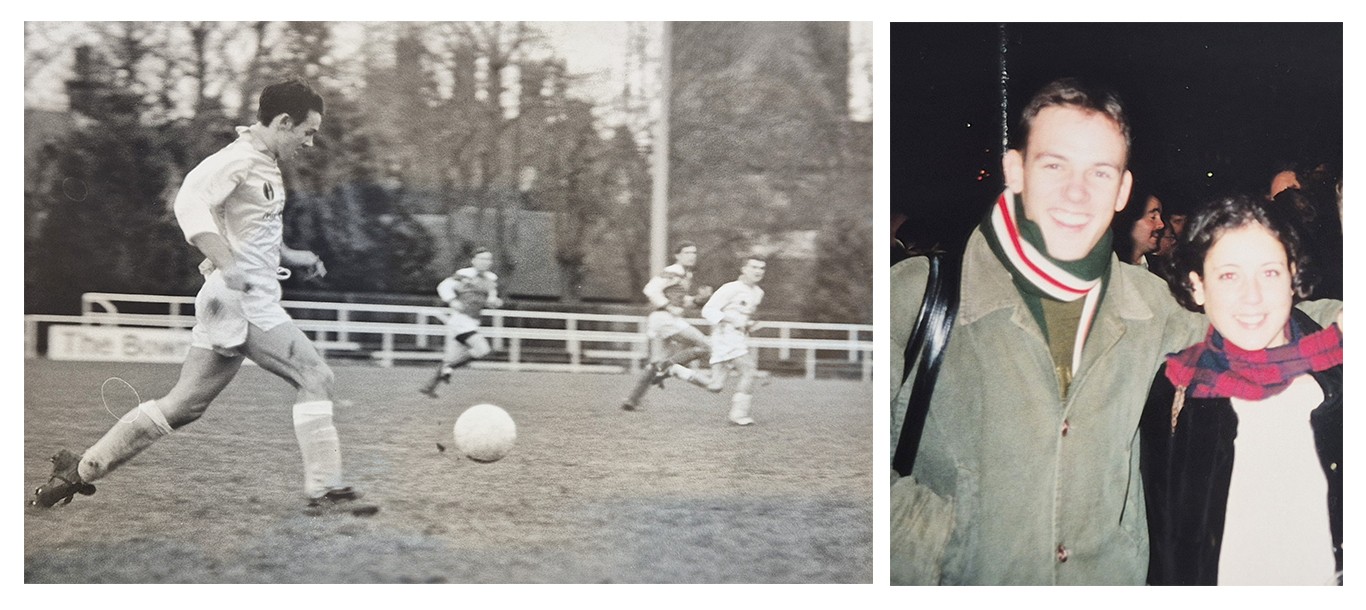
Left: Mark playing Blues football in his student days. Right: Mark with his now-wife Naomi during their time at Girton.