
Professor Nik Cunniffe, Fellow of Girton College and Head of the Theoretical and Computational Epidemiology group in Cambridge’s Department of Plant Sciences, is set to play a key role in a new European consortium building the first platform capable of coordinating Europe’s response to devastating agricultural and forest pest invasions.
Each year, plant pests destroy up to 40% of agricultural yields worldwide and threaten to devastate forest ecosystems, yet Europe still lacks the tools to coordinate an effective, system-wide response. PhytoPRISM, a new €6 million EU Horizon project, is set to change that.
Professor Nik Cunniffe, Cambridge lead for the project, said:
“PhytoPRISM is a vital opportunity to collaborate with a world-leading team of modellers across Europe. Our goal is to develop a platform that provides practical, data-driven support for decision-makers managing real-world plant health threats.”
A coordinated response to plant health threats
The project, led by the University of Warwick, brings together 15 research institutions and stakeholders across eight countries, positioning the UK at the forefront of a coordinated European response to transboundary plant health threats. It will give plant health authorities, for the first time, the ability to model and optimise pest control strategies across the entire agri-value chain, from preventing pest entry to long-term management.
"Until now, plant health authorities have had to make critical decisions without ever being able to see the full picture” said PhytoPRISM project lead, Dr Stephen Parnell from the University of Warwick. "They can apply individual measures but have no way of knowing how those measures interact, or whether they are getting the best outcome for their investment.
“PhytoPRISM brings together the best of modern epidemiological modelling with the real-world knowledge of the people on the frontline, giving them, for the first time, the tools to make smarter, faster, and more cost-effective decisions”
Plant pests, including insects and plant pathogens, pose a growing threat to agri-food and forest resilience. Driven by global trade and climate change, the continual introduction of new pests directly undermines European priorities around sustainable food production, biodiversity, and reduced pesticide use. Current management approaches are often piecemeal, relying on single restrictive procedures rather than coordinated, systems-level responses across the entire agri-value chain.
The Cambridge team will develop the project’s core computational framework, creating generic models to simulate how pests move across landscapes via both natural dispersal and human-mediated transport.
Professor Cunniffe has a long-standing collaboration with project partners including Dr Stephen Parnell, and Dr Antonio Vicent at IVIA in Spain. Together they were part of the core team that initiated PhytoPRISM, and all three also bring extensive experience from the EFSA Panel on Plant Health, helping ensure the new tools align with European risk management frameworks.
A platform co-designed with plant health authorities
Dr Antonio Vicent, Head of the Mycology Unit at IVIA and Chair of European Food Safety Authority’s (EFSA) Plant Health Panel, said “Citrus crops are threatened by a range of invasive pests that may enter European territory through international trade. PhytoPRISM will deliver tools for science-based risk management through a systems approach encompassing the entire food chain, ultimately contributing to safer and more secure international trade.”
The platform will be co-designed with plant health authorities, producers, foresters and advisers. Six high-profile European quarantine pest case studies will validate the platform, with outputs extendable to more than sixty closely related European quarantine pests. Training, e-learning, and contingency planning tools will further strengthen preparedness across Europe.
Dr Rob Tanner, Senior Scientific Officer at the European and Mediterranean Plant Protect Organization (EPPO), said “PhytoPRISM will develop state-of-the-art risk management tools through an open-access platform, enabling scientifically robust and harmonized management options to be set by National Plant Protection Organizations across the region.”
By reducing reliance on synthetic pesticides and enabling smarter responses to climate-driven pest dynamics, PhytoPRISM aims to provide more resilient and sustainable food and forestry systems across Europe. The project reflects renewed UK-EU research collaboration made possible by the UK’s association to the Horizon Europe programme.
Eriselda Canaj of AREFLH, said “by bringing together regions, researchers, farmers, and policy actors, PhytoPRISM seeks to strengthen knowledge exchange and develop effective solutions that contribute to a more resilient and environmentally sustainable horticultural sector across Europe.”
About PhytoPRISM partners
The project consortium brings together the University of Warwick (UK), University of Cambridge (UK), Wageningen University (Netherlands), INRAE (France), Rothamsted Research (UK), Forest Research (UK), ADAS (UK), Instituto Valenciano de Investigaciones Agrarias - IVIA (Spain), Università Cattolica del Sacro Cuore (Italy), Università di Parma (Italy), Prospex Institute (Belgium), EPPO (France), AREFLH (France), and Ceratium (Netherlands).
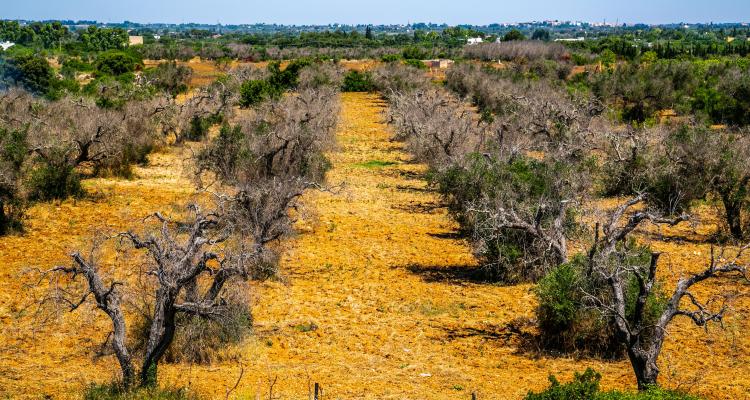
Image: Dead olive trees from xylella fastidiosa, Italy. Credit: Fabiomichelecapelli [https://www.gettyimages.co.uk/search/2/image?artistexact=Fabiomichelecapelli]. Getty Images.
Adapted from press releases by the University of Warwick and the Department of Plant Sciences, Cambridge.