
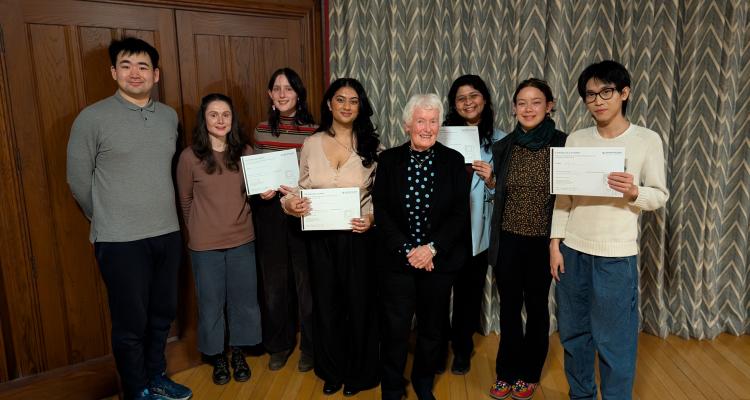
On Monday 16 February, Girton College celebrated the Mountford Humanities and Arts Communications Prize.
Each year, this prize invites students to showcase an object from any museum – no matter how unusual or obscure its importance. Participants are evaluated on how imaginatively, engagingly, and clearly they can convey their chosen object's meaning to an audience.
Entries were reviewed by both the audience and a judging panel, which includes Girtonian, Papyrology expert and TV personality Dr Margaret Mountford.
There are four prize categories: the judges’ winner, the audience’s choice, a prize for the best abstract, and a special prize for the best presentation about an object from the Girton's own museum, The Lawrence Room.
The four prize winners were:
- Olivia Hornakova (Audience Prize)
- Omera Shaikh (Abstract Prize)
- Raji Patwardhan (Judges' Prize)
- Zeyin Liu (Lawrence Room Prize)
We caught up with the prize winners to find out more about their presentations and what winning the prize means to them.
Raji Patwardhan (MASt in Law), Judges' Prize winner
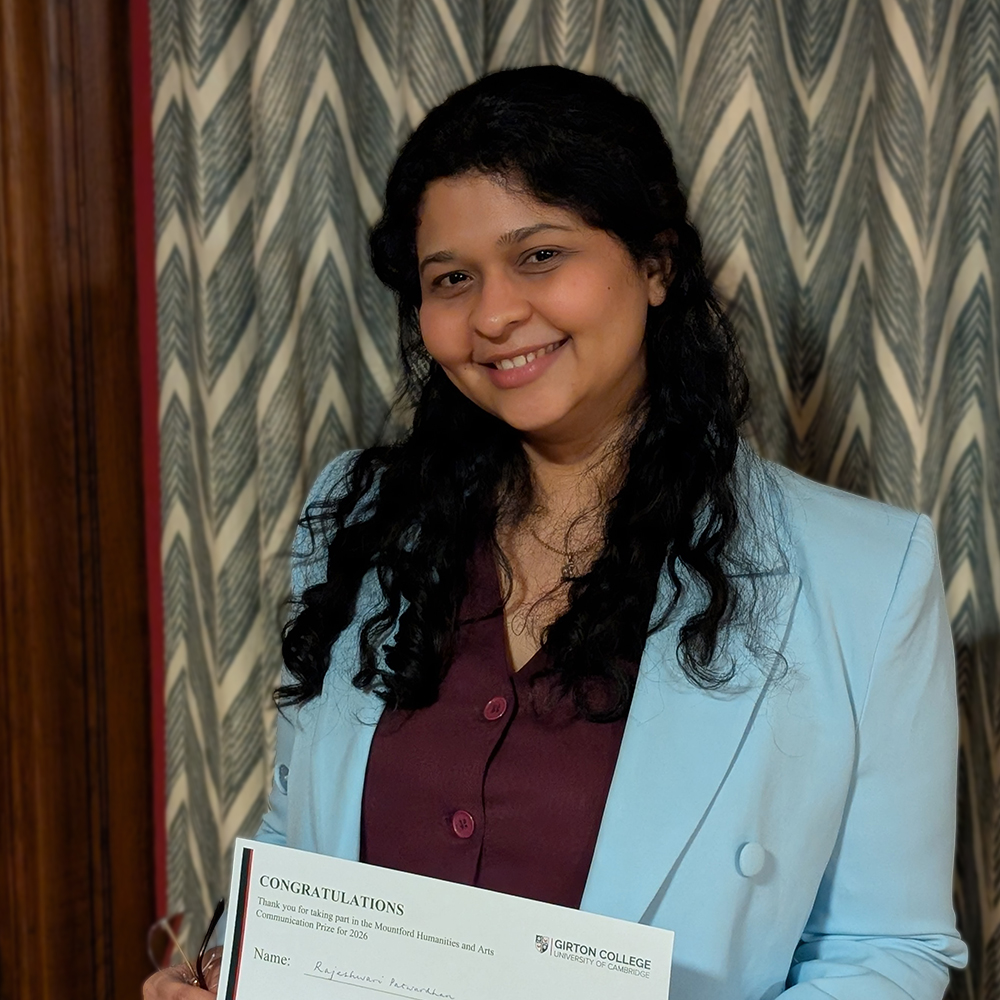 When I encountered the theme of 'Globalisation', my thoughts turned to the jewellery of the Indus Valley Civilisation that had made an impression on me when I briefly studied it in school. My presentation, titled “RGB Jewellery: The Primary Colours of the First Global Age,” explored how red carnelian from Indus Valley Civilisation (modern day India and Pakistan), blue lapis lazuli from Badakhshan (Afghanistan) and gold from Mesopotamia (now Iraq and Syria) were procured by the Indus people strategically, processed in finely crafted ornaments and then exported over 2,000 miles across Central Asia, the Gulf, Egypt and Greece for commercial value. These objects reveal sophisticated trade routes, specialised production techniques and an early understanding of value chains and consumer demand.
To make the experience tangible, I invited the audience to assemble a simple pendant by distributing a bead (carnelian and lapis lazuli alongwith other semi-precious stones), a pendant cage and a chain to each. The difficulty of this task especially impacted the understanding of the audience in comprehending the extraordinary skill of Indus artisans, who, all the way back in the Bronze Age, drilled, treated, transported and assembled raw materials into jewellery of consummate worth. I picked this RGB Jewellery as my “object from a museum anywhere in the world” to convey that globalisation did not begin with empire or industry but with peaceful commerce and aesthetic values.
Winning the Judges’ Prize was especially meaningful to me. Not only did it recognise my efforts but highlighted the technological and cultural sophistication of the Indus Valley Civilisation, which is often overlooked in global historical narratives. It affirmed the importance of presenting globalisation as a story of coordination rather than conquest. It also viewed jewellery not merely as ornaments but as evidence of economic networks, social structure and cultural connection.
I am grateful to Dr. Margaret Mountford and Girton College for creating a space where interdisciplinary passion projects can be shared and celebrated.
Omera Shaikh (History and Politics), Abstract Prize winner
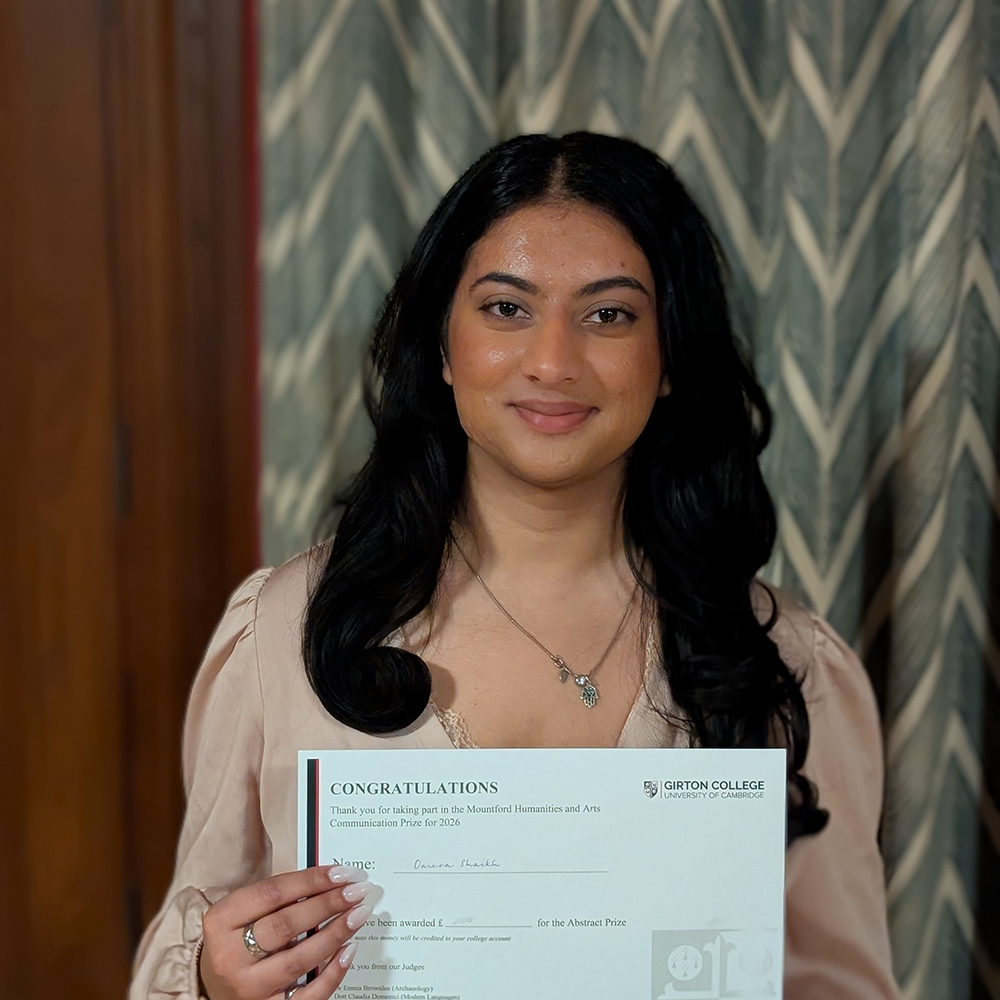 My presentation examined eight photographs and documents from East London, spanning 1952 to 1999. I grew up in the East End, my father arrived from India in the 1950s, my mother in the 1990s so these weren't images from a distant archive; they were from streets I know.
I grouped them thematically: skilled tailors (1953) and a saree shop bag (1993) traced forty years of knowledge migration from South Asia. A lascar seaman and Jewish street vendor showed "globalisation from below" - people moved by empire who then improvised their survival. An Asian family at home and an Irish dance class revealed how families preserve cultural identity. Finally, a paan note from Tayyabs and a halal meat shop record were artefacts of diaspora infrastructure, not just images.
My argument was that these objects aren't merely witnesses to globalisation but participants in it. Like objects in the Lawrence Room, they were preserved because someone judged them significant, and that act of preservation is itself part of how a globalised world understands itself.
Winning the abstract prize has reinforced my belief in the importance of individual and personal histories in the analysis of wider processes like globalisation. We often discuss these forces in terms of statistics and policies, but they're lived on street corners, in homes, through the daily choices people make about what to eat, what to wear, how to preserve who they are. The Mountford Prize gave me the opportunity to argue that those small, specific stories aren't just illustrations of global forces. They are the forces, made visible and particular.
Olivia Hornakova (MASt in Pure Mathematics), Audience Prize winner
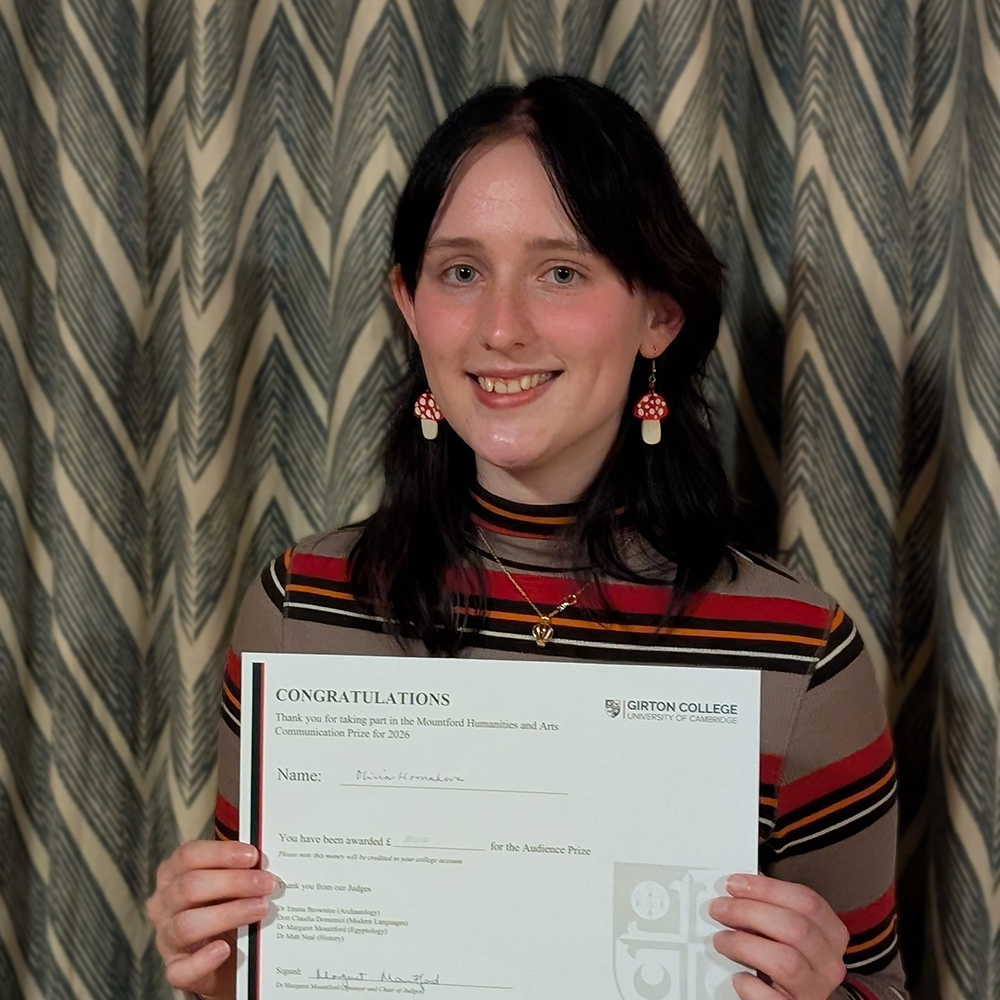 It is not often that I get the opportunity to write about topics I am passionate about that don't relate to my degree, and so the Mountford prize came as a true blessing. I was able to view a topic of my interests - Maya glyphs - through the lens of a museum artefact; the Dresden Codex. Though I had previously only read books and papers on the decipherment process of classic Maya glyphs, the Mountford prize theme of Globalisation encouraged me to take a different angle in my research: the history of the subjugation of the Maya, and how globalisation both destroyed and rebirthed their lost writing.
As one of only four surviving Maya codices due to the Spanish conquest of Northern Yucatán, the Dresden codex was vital to the decipherment of the enchanting lost script of the Maya (lost, of course, due to the Spanish efforts). Across the globe, scholars worked together to piece together vital context clues contained in the Dresden codex to allow them to decipher the meaning and language of the glyphs. The Dresden codex is a delightful testament to the failure of a concerted effort to eradicate the ancient Maya, and highlights both the failures and successes of globalisation in its many different forms.
Despite my anxiety around public speaking, it was to my shock and delight that I won the audience prize. I am grateful to everyone there who was able to see my passion through my nervousness, and I am happy to have been able to share my knowledge in such a niche topic. For a stem student especially, these opportunities are rare: it has meant the world to me to receive support from the audience, and also my fellow presenters, all of whom had such wonderful presentations and were incredibly lovely people. I hope we will be able to meet again!
Zeyin Liu (MPhil in Education), Lawrence Room Prize winner
 My talk was titled ‘The Gaze of the Grammatike—Epistemic Tension and the Fracture of the Global in Roman Egypt’. Hermione is a portrait mummy from Roman Egypt, dating back to the 1st century AD, and is currently housed in Girton’s own Lawrence Room. What fascinates me most is the complex identity she embodies: her realistic Fayum portrait signifies her social standing within the Roman Empire; her title ‘Grammatike’ identifies her as a bearer of Greek letters and intellectual culture. Yet, this guardian of Greek Paideia met her end through a distinctly ancient Egyptian ritual of death. This juxtaposition—clinging to Greek education and Roman order in life, while transitioning into the afterlife through the tradition of mummification—makes Hermione a testament to cultural hybridity in early globalisation.
Participating in the Mountford Prize was a profound experience, especially as the competition fell on the eve of Chinese New Year. In an event that celebrates cross-cultural communication, sharing a story of cultural intersection with people from all over the world and from diverse backgrounds felt incredibly symbolic. It reminded me that the human desire to navigate different cultures and seek a sense of belonging is universal, whether in 1st-century Egypt or modern-day Cambridge. Winning this prize is a great encouragement; it proves that discussions on globalisation can truly resonate with people when told through a compelling narrative. I hope Hermione’s journey inspires others to reflect on how we define ourselves in our own increasingly interconnected world.