Call for submissions
We are inviting submissions of abstracts. We offer early-career researchers and students the option of giving flash talks or presenting posters. Established researchers should submit for contributed talks (20 min including questions).
Abstracts are limited to 200 words maximum, excluding any references. Abstracts supported by a recently published paper or an arXiv preprint will be prioritised. People may only submit one abstract to be considered for a presentation but can appear as a co-author on several.
Drawing on our 1869 founding principles of Girton College, we recognise that significant hardships and inequalities persist within the field of quantum physics today. We are dedicated to fostering a diverse academic environment and encourage applications and participation from speakers belonging to underrepresented communities.
Submissions are now closed.
Invited speakers
Dates:
- Submission open: 3 April
- Submissions close: 19 May
- Notifications: 25 May
- Registration deadline: 4 July
- Conference: 15 – 18 September
Schedule
The programme will run from 9.30am to 4.00pm with a lunch break for discussions.
Girton organising committee
- David Arvidsson-Shukur
- Crispin Barnes
- Stephan De Bièvre
- Hugo Lepage
The Cambridge Connection
The development of the foundations of quantum technologies is closely intertwined with scientific work carried out at Cambridge. At the end of the nineteenth century, experiments at the Cavendish Laboratory led by Thomson established the existence of the electron. Later, Ernest Rutherford revealed the nuclear structure of the atom, providing essential empirical foundations for quantum theory. In the 1920s and 1930s, Paul Dirac played a central role in formulating the mathematical structure of quantum mechanics and in unifying it with special relativity. In the early 1960s, Brian Josephson, then a graduate student at Cambridge, predicted the Josephson effect, which laid the foundations for superconducting circuits and many modern quantum processors. Today, diverse research on quantum information and quantum technologies is pursued across the Cavendish Laboratory, the Department of Applied Mathematics and Theoretical Physics, the Department of Engineering, the Department of Chemistry and the Department of Computer Science and Technology.
The venue
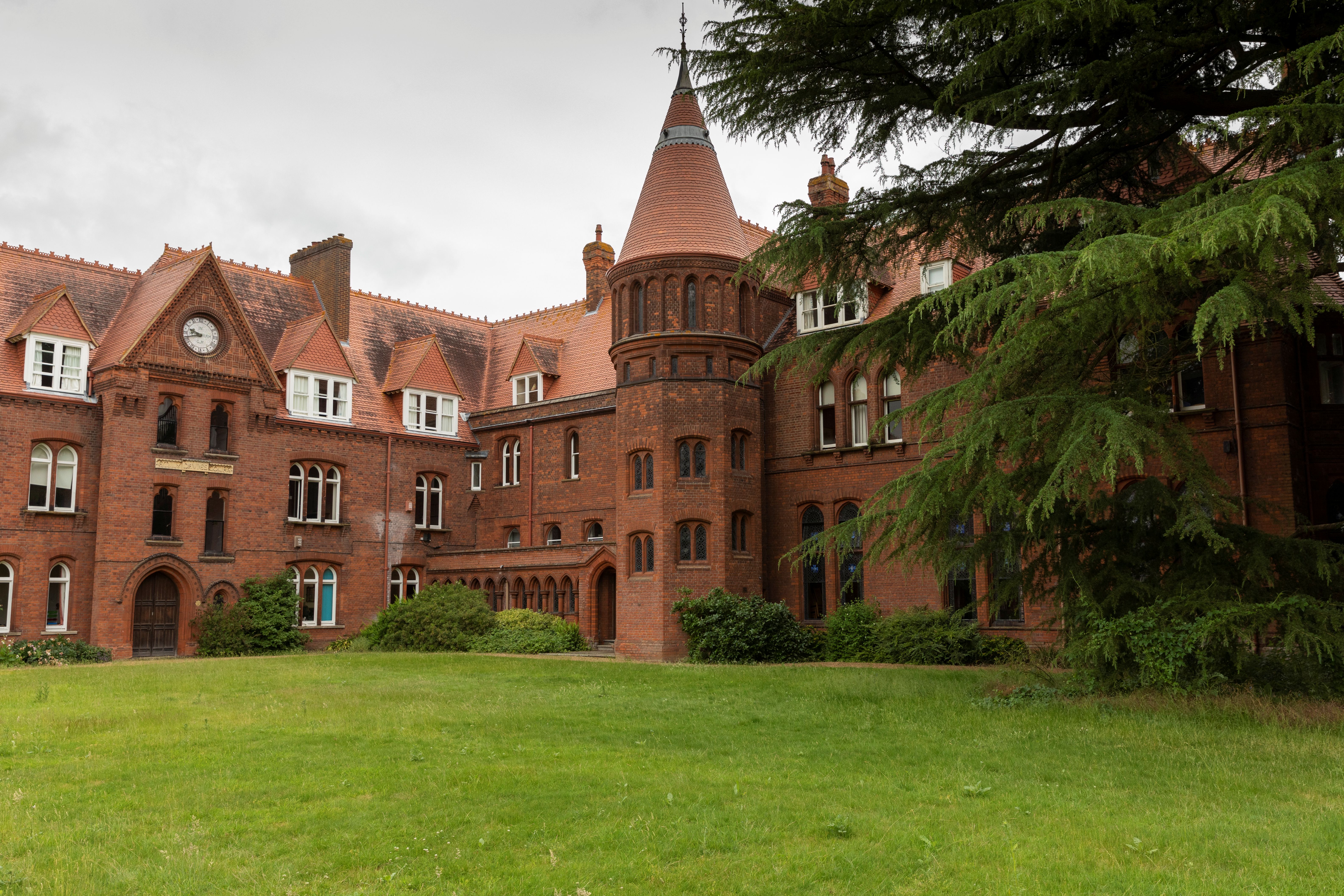
Girton College is renowned for its striking Victorian architecture and extensive grounds, whose many flower gardens and orchards offer a calm and beautiful environment for creative scientific discussions. Founded in 1869 as the first women’s college in Cambridge (and later the first to admit men alongside women), Girton has a distinguished scientific legacy, including the work of Bertha Swirles, whose contributions to early quantum mechanics and relativistic quantum theory helped shape the development of twentieth-century physics.
Registration
The cost of registration is: 350GBP per person. This includes daily lunches and snacks and coffee during the conference. The registration also includes a Gala Dinner in the historical hall of Girton College.
How to get here
The nearest airport to Cambridge is Stansted Airport, which has regular bus and train connections (35minutes or so) to Cambridge. There is a less frequent direct train from Gatwick Airport to Cambridge (around 2h). Passengers flying into Heathrow or London City Airports should get a train to Cambridge from Farringdon, King’s Cross or St Pancras in London. The journey from London takes about 1h. Girton College is situated in Girton village, 2 miles from Cambridge’s historical city centre. There are busses from Cambridge train station to Girton. But a taxi ride is significantly quicker (around 15min) and affordable.
Accommodation options
We are holding a number of ensuite student rooms at Girton College which can be booked at a discounted rate. Priority will be given to accepted speakers. Cambridge also hosts a range of hotel and B&Bs of various budgets.
Options near Girton College include:
- Turing Locke Cambridge Hotel, 47 Eddington Ave, Cambridge CB3 1SE, United Kingdom
- Hyatt Centric Cambridge, 37 Eddington Ave, Cambridge CB3 1SE, United Kingdom
- Premier Inn Cambridge North (Girton) hotel, Huntingdon Rd, Girton, Cambridge CB3 0DL, United Kingdom
Contact
For any queries, please contact: quantum(at)girton.cam.ac.uk