Humanities Writing Competition
The 2025-26 competition is now closed. The 2026-27 competition will launch in Autumn.
This is an opportunity for students in Year 12 or equivalent to research and write beyond the curriculum, using one or more of five selected objects from the Lawrence Room museum objects, as their focus. Essays or creative responses (such as dramatic monologues, short stories or poems) are equally welcome.
The objects in the Lawrence Room that have been chosen as starting points for this year’s competition are:
- a Leigong figurine from late nineteenth or early twentieth century China, a deity known as the "Thunder God";
- an eye idol, discovered by Agatha Christie's husband Max Mallowan in Tell Brak;
- an apis bull figure dating from BC 664-525, of Egypt;
- a wooden seated man, from the late Old Kingdom to the late Middle Kingdom periods of ancient Egypt;
- bronze casket fittings, in the shape of lion heads, discovered in the Roman and early medieval cemetery at Girton College.
You can find videos on our social media of Dr Caroline Brett (Director of Studies in Anglo-Saxon, Norse, and Celtic) and Dr Helen Van Noorden (Director of Studies in Classics) discussing the chosen objects:
- @girtonoutreach on Instagram
- @girtoncollege on TikTok
Girton is grateful to Cambridge University Press and The C. Anne Wilson Fund for kind sponsorship of the competition.
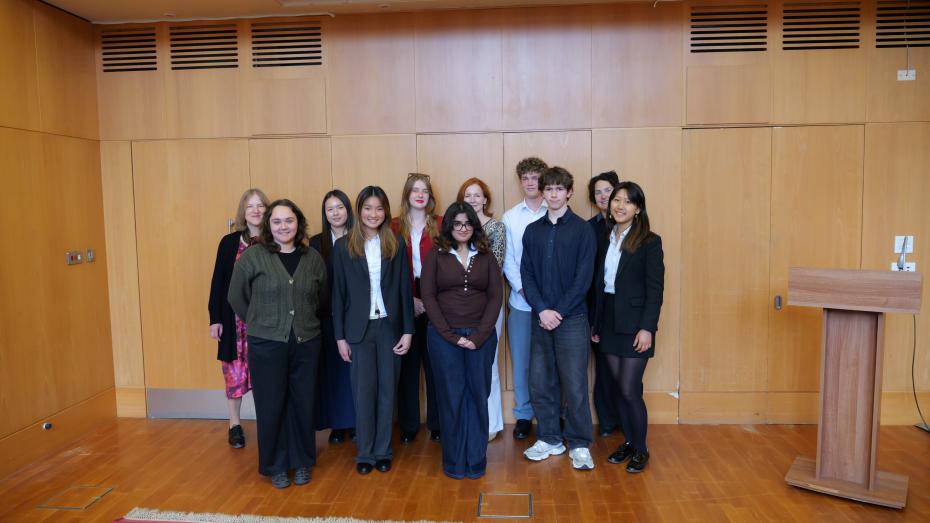
2025-26 Winners
Thank you to all the competitors for taking part. We do not provide detailed feedback on individual essays other than those of the winners, but all entrants will be awarded a certificate in recognition of their participation.
Further information on the prize-giving ceremony can be read here.
‘Holding a god: the human desire to touch the divine’
Harry’s essay discussed the eye idol and the Apis bull as two objects which in different ways tried to collapse the distance between the divine and the human. The argument paid close attention to the two objects themselves and also drew on a wide range of comparative material. A judge described this as ‘an amazingly confident, flowing, well-structured essay’ and another as ‘a serious piece of work, thoroughly referenced’. This is university-level writing with a sophisticated point of view informed by in-depth knowledge.
‘Feed’
Taking the eye idol as a starting point, this poem explores the theme of seeing and being seen, from the enigmatic gaze of the idol to the all-encompassing gaze of social media. A judge commented that ‘the verse is authoritative, alert and non-gimmicky’. Another said: ‘I would love to hear this read aloud and the text and recording QR’d with the eye idols in the Lawrence Room.’
‘To Be Seen: the eye idol and the secular afterlife of sacred attention’
Starting from a glimpse of a visitor taking a selfie with the idol in the Lawrence Room, it explores the idea of intervisibility between worshipper and divine protector, and the blurred lines between divine recognition and social fame, through an impressive range of examples from different cultures. Very confidently done: a genuinely personal take supported by wide knowledge, and good referencing too.
Emeline Ang - ‘Mapping Lei Gong’s iconography’
This essay is a deep dive into history, a well informed and fully referenced account of the changing image of the thunder deity over the centuries, from the Tang dynasty to his latest incarnation as a Marvel hero.
Ciara Herbert - ‘The Offering’
This was the best of many short stories that were submitted. It worked the eye idol (again) into a poignant story about a normal day that ends tragically for two Syrian children. The children’s experience was vividly rendered both familiar and unfamiliar through the lens of a different culture. The work of a talented and practised writer.
Abby Lam - ‘How do the objects in the Lawrence room of Girton College symbolise the human need for physical anchors in metaphysical journeys?’
The Egyptian seated man, the Apis bull and the Romano-British lion heads were all discussed as varied embodiments or defences for the dead against non-being, and there was a neat ending about the role of the museum in continuing this embodiment. A very well thought through and philosophically ambitious essay.
Leyi Wang - ‘Commercialisation of votive offerings: sacralising or secularising?’
Another essay that found a way to discuss the parallels and contrasts between several different objects – the seated man, Apis bull and eye idol. It looked at how votive offerings – ‘a conditional exchange of gifts between men and gods’ in Burkert’s words – could work to extend the moral community created by a religion. A well-chosen and interesting perspective and a good bibliography.